Best-Selling US Solar, LiFePO4 Battery & Inverter Gear
Curated, high-efficiency hardware tested for US 110V–120V AC household appliances, off-grid RVs, and emergency backup battery banks.
Renogy 300W 12V Pure Sine Wave Power Inverter
- 300W Continuous / 600W Surge
- Total Harmonic Distortion (THD) < 3%
- Dual 5V USB Ports + 120V AC Outlet
BESTEK 500W Pure Sine Wave Power Inverter 12V DC to 110V AC
- 500W Continuous / 1000W Peak Surge
- Silent Temperature-Controlled Smart Fan
- Includes Battery Clamps & Cigarette Adapter
Renogy 1000W 12V Pure Sine Wave Inverter with Remote
- 1000W Continuous / 2000W Surge Rating
- 90%+ Peak Conversion Efficiency
- 16.4ft Wired Remote Control Switch
Victron Energy Phoenix 12/1200 Pure Sine Wave Inverter
- SinusMax High Startup Inrush Capability
- VE.Direct Communication & App Monitoring
- True Low Idle Power Standby Mode
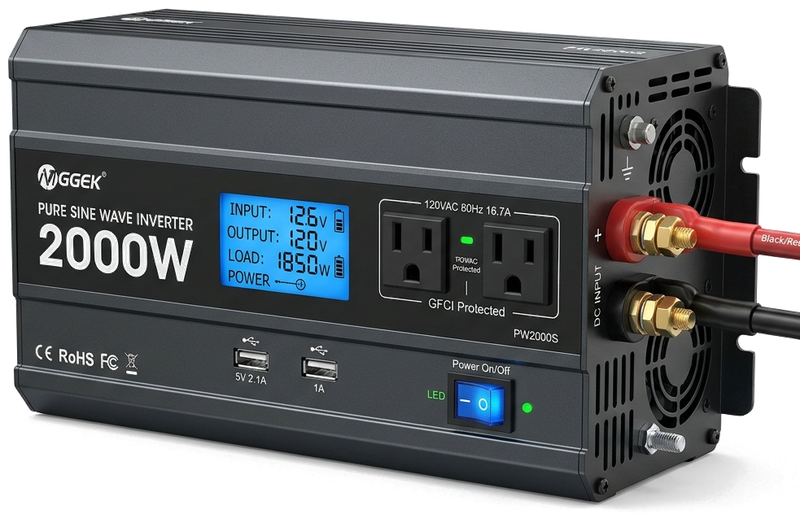
Renogy 2000W 12V Pure Sine Wave Inverter
- 2000W Continuous / 4000W Surge Peak
- Handles Microwaves, Fridges & Power Tools
- Built-in AC Hardwire Terminal Block
GIANDEL 2200W Pure Sine Wave Power Inverter (12V DC)
- 2200W Continuous / 4400W Surge
- Wireless & Wired Remote Controls Included
- Dual 120V AC Sockets + 2.4A USB
Renogy 3000W 12V Pure Sine Wave Inverter Charger
- 3000W Continuous / 9000W Surge (1 second)
- Automatic Shore Power Transfer Switch
- Multi-Stage Smart Battery Charger (75A)
AIMS Power 4000W 24V Pure Sine Wave Inverter
- 4000W Continuous / 8000W Surge Peak
- 24V DC Architecture Reduces Cable Gauge
- UL 458 & CSA Certified for US Homes
How to Size Your US Hardware Accurately
Critical rules based on the National Electrical Code (NEC) & UL standards
Always select LiFePO4 lithium batteries over lead-acid when possible. LiFePO4 delivers 90% usable depth-of-discharge and 4,000+ full cycles, whereas AGM/gel batteries suffer irreversible plate degradation if discharged past 50%.
Inductive loads (compressors, refrigerators, sump pumps, microwaves) draw 2x to 3x their continuous wattage on startup. Ensure your Pure Sine Wave Inverter provides enough surge headroom to prevent low-voltage inverter shutdown.
To calculate solar panel wattage, divide your total battery capacity in watt-hours by 5 peak sun hours, then multiply by 1.25 to account for MPPT and atmospheric absorption losses.
Amazon Associates & FTC Affiliate Disclosure
TheDivineX.com is a participant in the Amazon Services LLC Associates Program, an affiliate advertising program designed to provide a means for sites to earn advertising fees by advertising and linking to Amazon.com. Product prices and availability are accurate as of the date/time indicated and are subject to change. Any price and availability information displayed on Amazon.com at the time of purchase will apply to the purchase of this product.